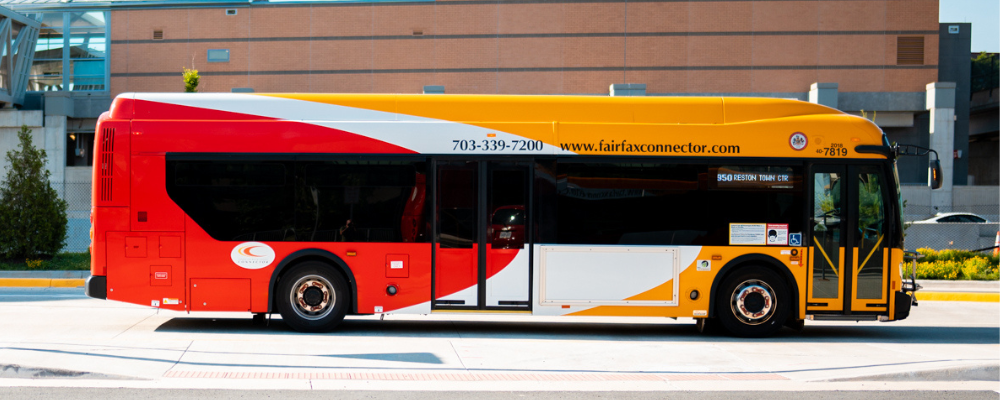
Reston commuters who ride Fairfax Connector to Metro are sharing the road with cleaner buses. The Fairfax County Department of Transportation is deploying 19 new hybrid-electric buses across the system during summer 2026, with 36 more anticipated by year-end.
The buses already entering service were built by New Flyer Industries and cost about $1.1 million each, purchased with state funding. They replace retiring diesel buses as part of the system's fleet replacement program.
FCDOT Transit Division Chief Dwayne Pelfrey said the investment supports the county's environmental goals. "Hybrid-electric buses are expected to provide approximately 25% fuel savings and a 30% reduction in greenhouse gas emissions compared with traditional diesel buses," Pelfrey said in the county's announcement Monday, "helping Fairfax Connector move toward a more environmentally sustainable fleet."
Each bus uses geofencing technology that switches it to battery-only power in designated zones. How long a bus stays fully electric depends on operating conditions and battery charge. Outside those zones, it runs as a standard diesel-hybrid.
The second batch of 36 buses, manufactured by California-based Gillig Corporation, is funded through a Federal Transit Administration Low or No Emission Grant. In July 2024, Sens. Tim Kaine and Mark Warner announced Fairfax County had secured more than $50.5 million from that program, according to FFXnow. FCDOT said only that the Gillig buses are expected to enter service "toward the end of the year."
Fairfax Connector operates 93 routes with a fleet of 374 buses, the third-largest in the Washington region, carrying about 29,700 riders on an average weekday. Reston-area routes, including RIBS 1 through 5 and routes 507, 553, 557, 558, 559, 574, 598, 605 and 950, connect neighborhoods to Wiehle-Reston East and Reston Town Center Metro stations on the Silver Line. FCDOT's announcement did not specify which routes will receive the new buses first.
As of July, about 13% of the county-owned fleet was powered at least partly by electricity, according to FFXnow. The 55 new hybrid-electric buses will push that share higher. Fairfax County had set 2035 as its target for phasing out gas and diesel vehicles entirely, but a consulting study released in late 2025 concluded that deadline is no longer achievable.
The 36 Gillig buses are expected to enter service by year-end. FCDOT has not named which routes will get them first.

.png)