
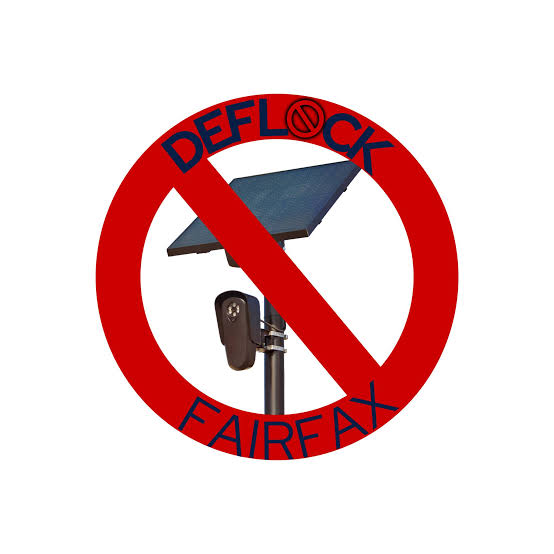
Reston residents are among the Fairfax County drivers whose movements are logged daily by a growing network of license plate reader cameras, and opposition to the program is gaining traction across the county and the state.
About 100 people packed Ravensworth Baptist Church in Annandale on Saturday, Aug. 22, for a forum organized by advocacy group DeFlock Fairfax. The event featured research linking camera placement to historically redlined neighborhoods and drew a formal response from Fairfax County Police Department (FCPD), which defended the program with case data. Del. Irene Shin, a Fairfax County Democrat, called on Aug. 25 for state legislation to force public disclosure of who searches the cameras and why.
The cameras, manufactured by private company Flock Safety, record every passing vehicle's license plate and upload the data to searchable databases, Northern Virginia Magazine reported. That tracking happens whether or not a driver is suspected of breaking the law. FCPD operates the cameras county-wide, including in the Reston District Station's coverage area. A recently published list shows 161 Virginia law enforcement agencies can search the network, and both Fairfax County and Herndon appear on it.
Redlining research and resident reaction
Dr. Steven Keener, a board member of Justice Forward Virginia and director of the Center for Crime, Equity, and Justice Research and Policy at Christopher Newport University, presented at the forum. DeFlock Fairfax founder Matthew Lofgren, a software developer, said Keener's research showed that some automated license plate reader (ALPR) cameras in the area are mapped almost exactly with formerly redlined neighborhoods.
Lofgren estimated more than half the attendees emailed their county supervisors after the event.
Fairfax County resident Alexandra E. said she attended because she had noticed the cameras multiplying. "I'm noticing these black poles with solar panels popping up more and more. … Places where you wouldn't expect them – like schools and near business," she said.
Police defend the program
FCPD said in a statement that its license plate reader technology has helped file charges in 1,700 cases since 2022, including a homicide. The department also said the cameras have helped recover more than 500 stolen vehicles and locate 57 missing people.
FCPD said its staff spends about 40 hours each month auditing search activity for abnormal patterns or possible misuse. Each monthly audit goes to a commander for additional review. The department said it does not receive alerts tied to immigration enforcement warrants, driver's licenses, registration or inspection violations.
Transparency gap
Virginia law limits ALPR use to tracking people in cases involving state or local law violations, missing persons and human trafficking. Data must be deleted after 21 days unless tied to a legal case. The same law exempts ALPR audit logs from Freedom of Information Act (FOIA) requests.
"FOIA requests are the way that journalists and citizens have discovered the abuses of ALPR cameras," Lofgren said. "That's how we found out that cops were stalking their ex-girlfriends. That's how we found out they were surveilling protesters. … And now in Virginia, you're not allowed to issue FOIA requests for ALPR audit log data. So we don't know how they're being used."
A 2025 Virginia State Crime Commission report found that about 16% of police agencies statewide lacked a required ALPR policy. One-third did not respond to the commission's questions at all. The report does not name which departments are compliant.
Del. Shin told Virginia Public Radio on Aug. 25 that, at minimum, ALPR search data must be made public. No specific bill number or hearing date has been announced.
Statewide momentum
Five Virginia localities have already cut ties with Flock and other ALPR providers, according to DeFlock Fairfax: the cities of Staunton and Charlottesville, the towns of Elkton and Warrenton, and Floyd County. On Aug. 28, Goochland County Sheriff Steven Creasey announced a suspension of Flock cameras, citing community input, privacy concerns and what he called the "evolving legal landscape."
FCPD publishes information about its surveillance oversight on its Real Time Crime Center transparency page.




.png)