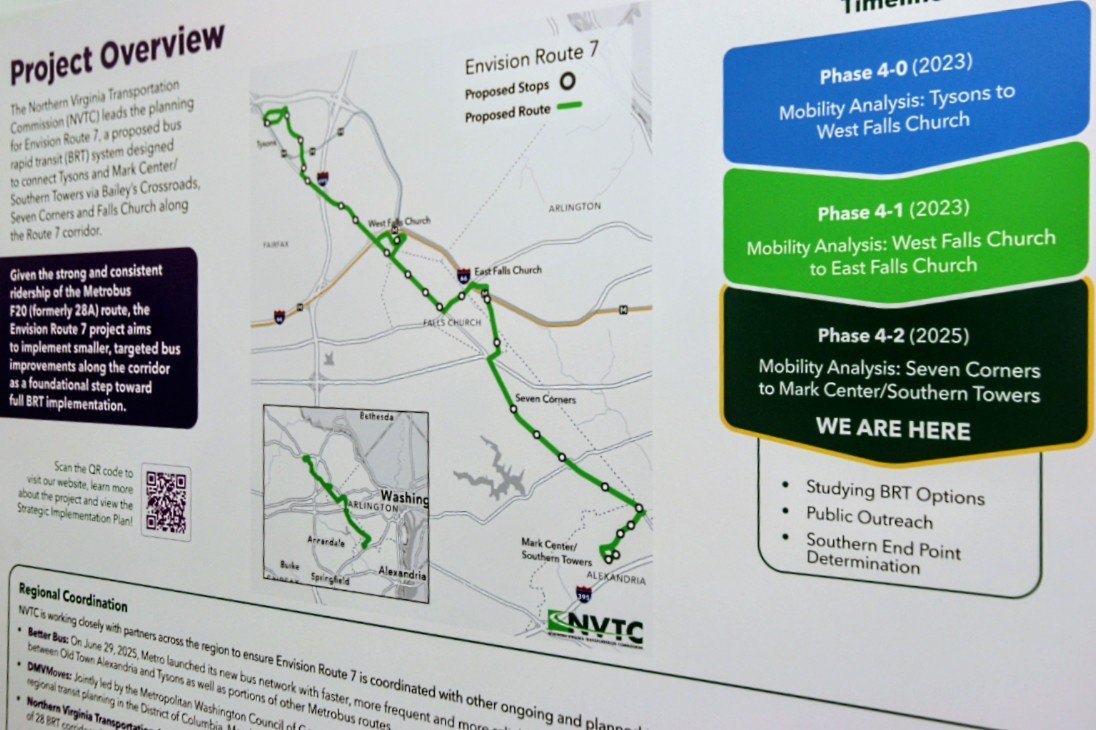
Six out of 10 bus riders along Route 7 want to keep boarding at the curb when rapid transit arrives on the Tysons-to-Alexandria corridor, according to a new survey from the Northern Virginia Transportation Commission. But elected officials from across the region say that preference shouldn't take center-running stations off the table.
The survey results, presented at NVTC's July 2 meeting, land squarely in a debate that will shape how commuters across the corridor, including Reston-area riders, experience the planned 14-mile bus rapid transit line for decades. Center-running stops, placed in the road's median, could deliver faster and more reliable service. Curbside stops are what riders already know.
NVTC senior project manager Vikram Sinha said riders' main worry about median stations was safety: "Their concern was crossing that many lanes of travel, waiting for the walk signal so they are not taking an unnecessary risk."
The remaining 40% of respondents were divided between those who supported median stops and those with no opinion. The survey also found 88% of riders want transit stops placed near storefronts.
Officials want the option preserved
Arlington County Board member Takis Karantonis pushed back on the curbside preference at the July 2 meeting, noting that median-based stations are already the norm on Metroway, the BRT line connecting Arlington and Alexandria.
"There's always a tradeoff," Karantonis said. "If service is the number-one parameter … center-running is probably the better choice."
Mount Vernon District Supervisor Dan Storck echoed that view. Center-running stops will be the standard on The One, Fairfax County's future BRT line along Richmond Highway. Storck said the survey results shouldn't rule out a median system, arguing that riders may simply be comfortable with what they have rather than open to something unfamiliar.
VDOT holds the cards
Sinha acknowledged that not all stakeholders carry equal weight in the decision. VDOT owns Route 7 through most of the corridor and is the top stakeholder in BRT planning, Sinha said.
VDOT has already begun planning to widen the Tysons stretch of Route 7 between Route 123 and the Capital Beltway to accommodate BRT service without reducing regular travel lanes.
The Route 7 BRT project spans four jurisdictions: Fairfax County, Arlington, Alexandria and Falls Church. Decision-making also involves VDOT, the Virginia Department of Rail and Public Transportation, and WMATA. Metro's F20 bus line, which runs along Route 7, carries the highest ridership of any single bus line in Virginia.
What comes next
The Envision Route 7 project is in its final stage of data analysis and public outreach before more intensive planning begins. NVTC officials aim to start considering funding options for a comprehensive corridor upgrade by 2028.
Falls Church City Council member David Snyder said at the July 2 meeting that he hopes the project can move from planning into implementation by fall 2026. That timeline is more aggressive than NVTC's own 2028 target for beginning to weigh funding.
Residents can follow the project and submit feedback at NVTC's Envision Route 7 page (novatransit.org/programs/route7/).



%20(1).webp)