Reston homeowners and businesses are headed for higher trash costs after Fairfax County officials acknowledged that the reserve fund subsidizing the solid waste system will be fully depleted by the end of June 2027.
Hunter Mill District Supervisor Walter Alcorn, who represents Reston, voiced frustration at the county's Environmental Committee meeting on Tuesday.
"My big frustration is we didn't have this conversation three or four years ago," Alcorn said.
The problem is straightforward: Fairfax County's $90-per-ton tipping fee, already the highest among local government systems in the region, still won't cover operational costs starting in fiscal year 2028. The reserve fund that has been filling the gap runs out this fiscal year.
About 90% of Fairfax residents use private haulers, often contracted through their HOA. Those haulers are required by county law to use Fairfax facilities, including the I-66 Transfer Station that serves Reston-area routes. When tipping fees rise, haulers pass the cost to customers.
What's on the table
Christopher Herrington, director of the county Department of Public Works and Environmental Services, told the committee the county can get through fiscal year 2028 using a patchwork of roughly $6 million in savings. But he warned there is "no silver bullet" for the years beyond.
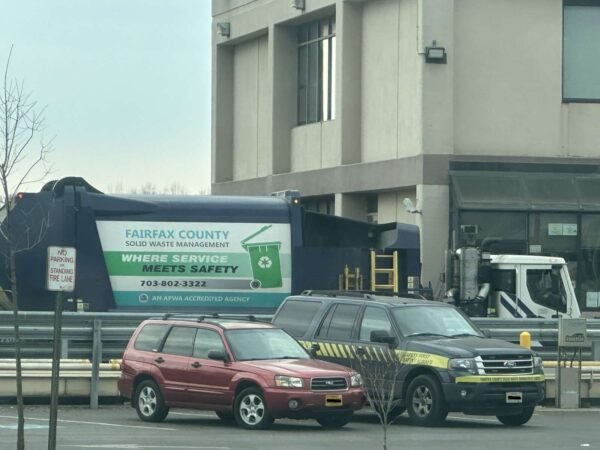
Staff presented a menu of revenue options at the July 7 meeting: a sustainability fee averaging $60 per household, a general fund subsidy, increased enforcement of illegal dumping ($2 million), a higher plastic bag tax ($1 million), and corporate sponsorships on trash trucks ($1 million). None of the smaller options alone would close the gap.
On the cost side, a one-year freeze on non-mandatory capital projects could save $5 million, and eliminating contract hauling could save $4 million but would require adding nine full-time employees and coordinating with unions.
What's already been rejected
Supervisors shot down the $60-per-household sustainability fee in May. Board Chairman Jeff McKay called it "a hard sell." Staff also listed eliminating the I-66 Transfer Station as "not feasible."
A unified sanitation district model, which would have the county contract directly with private haulers on behalf of residents, was shelved in May after public and industry pushback. State law would require five years' notice to displaced haulers before any such change.
How the system works
Each Fairfax County resident produces about one ton of trash per year, according to county data. That trash flows from the I-66 Transfer Station to the I-95 Energy Resource Recovery Facility in Lorton, operated by Reworld Fairfax Inc., which burns waste to generate electricity. About 600,000 tons pass through the system annually.
County Executive Bryan Hill said he will begin developing the fiscal year 2028 budget proposal but did not provide a specific timeline. He acknowledged that using general fund tax revenue to subsidize trash operations remains on the table, though he would prefer to avoid tapping those already-tight funds.
Supervisors Rodney Lusk, Jimmy Bierman and McKay offered to raise the issue with regional partners through the Metropolitan Washington Council of Governments. Herrington cautioned that neighboring jurisdictions have shown limited interest in collaboration so far.


%20(1).webp)